Posts Tagged ‘energy efficiency’

Blog CFL color diy duct tape environment Google heat how-to insulation Kill-A-Watt LED lighting methane mylar Projects radiant barrier science project solar panels wind turbines

Touring Google’s solar panel installation

Sunday, May 17th, 2009

This past week I got a chance to take an up-close look at the solar panels up on the roof at work. My building doesn’t actually have solar panels yet, but many of the main campus buildings and carports do. I grabbed one of the campus bikes and headed over to meet up with the green committee and take a quick tour. Since I’m writing about my place of employment, the standard disclaimer applies.
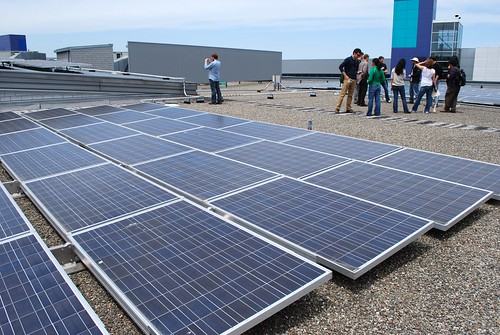
Tour of the solar panels at Google

At the time the panels were installed, it was the largest corporate PV project in the country. Coming from Ohio to a sunny state like California, it’s a little surprising that Google’s 1.6MW project in 2007 was so groundbreaking. I think part of the problem has been that it takes a few years to see the return on the investment, and for the past decade or so everyone’s been so caught up in the short term. The company expected it would take 7.5 years for the system to pay for itself, but given the way utilities charge for peak load I hear we’re even ahead of that mark.

Here are a few closer shots of the panels:

(more…)

LED Bulbs vs. Compact Fluorescent: Part II

Friday, May 1st, 2009

DSC_0662 I wanted to revisit an earlier post comparing LEDs, CFLs and traditional incandescent bulbs. I found two different values for the power and light output of the Lemnis Lighting Parox II bulbs, and same folks at work were wondering the same thing.

I decided to bust out my trusty Kill-A-Watt and see how much power the bulb was really drawing.

I watched the meter for a bit and it never went above 4 Watts. So that’s a bit of a bonus. Out of curiosity I decided to plug my CFLs in and see how much power they actually drew.

The 15W CFL spiked to 18W for a second but then settled in at 12W. After a while it climbed up to 13W and would have presumably stayed there. The 7W CFL globe settled at 5W. The incandescent was the odd one of the bunch, measuring 63 W instead of 60W. So when you replace those old lightbulbs, you may be saving a little more than you think.

Here’s the updated spreadsheet:

Again, the total lumen output might not be directly comparable because the LED bulbs really only emit light from a half globe, while the other bulbs cast light in almost all directions. Depending on the fixture this might make the LED seem brighter in comparison.

How do LED lightbulbs compare to CFL and incandescent?

Saturday, April 25th, 2009

Spectrum of an LED light bulb One of the great things about working at Google is the company’s commitment to the environment. This week for Earth Day the company gave each employee two LED light bulbs – much more efficient than regular old incandescent bulbs and better in some ways than the twisty compact fluorescent (CFL) bulbs I already have around the house.

Energy efficiency is one thing, but how do all these different lights compare visually? Three important measures to look at are the color temperature, the color rendering index (CRI), and the light output in lumens. I’ll talk a bit about both and explain a simple science demonstration you can do in your own home.

(more…)

Project: Warm up a room with an Insulating Wall Hanging

Tuesday, February 12th, 2008

When we moved into our new house, it quickly became apparent that we would need to do something to warm up the master bedroom. It was the coldest room in the house, and November weather in Cleveland is a pretty good motivator.

So I started trying to think of ways to warm up the room. Traditional methods of insulation were out of the question in the short term – the large open attic above was too big of a project to do at the time and we couldn’t use something like blown-in cellulose insulation because our stately Tudor duplex had knob-and-tube wiring. I came up with this fast, cheap, easy-to-build project instead. You can use it to decorate your room and even save you a few bucks on your heating bill.

Here’s a sneak peak at the end result:

Heat-reflecting and stylish

It’s basically a frame with some stylish fabric stretched over like the canvas in an oil painting. It’s backed with mylar which means it acts as a radiant heat barrier, keeping you toasty.

Here’s what you need:

  • Some 1×2′s – buy whatever is cheapest (and not warped) at your home improvement store.
  • Wood screws – maybe 1 1/2 inch to 2 inch.
  • Cloth – something that would look nice on the wall. Pick out whatever you like, it should be a little stretchy.
  • Aluminized mylar – better known as space blankets. Order it online or buy it at the store – it should be a dollar or two for a large sheet.
  • Duct tape (of course)
  • Some tools: A staple gun (and staples), tape measure, drill, screwdriver, saw.

So first, a tiny little bit of theory. Heat moves in three ways – convection, conduction, and radiation. Your house is losing heat in the winter because of these three along with air infiltration – drafts of cold air from windows and doors. Most insulation does it’s job by preventing conduction (by putting air pockets between materials) or by stopping convection in air pockets. Infiltration can be combated with storm windows, weather stripping, and vapor barriers.

Insulation is measured by R-value. This project will only help a little bit when it comes to convection or conduction – the main point here is to reflect radiant heat back into the room. So don’t ask about the R-value – like other radiant barriers, that’s not really the point.

(more…)