Monthly Archives: February 2008

Tricky little issue in Gmail – how do you find the original sender of a forward?

DSCN9755 I ran across a confusing issue in Gmail and I’d like to share what I did to resolve it.  It seems that Gmail won’t show you the original sender of a forwarded email by default in many cases.  Here’s how I found the issue and what I did to correct it.

My wife and I have a shared blog that automatically sends out updates to subscribers via Feedburner.  Feedburner is a great service if you have a blog, and you can use it to subscribe to my feed and get updates when I write on this blog as well.

When friends and family reply to an email from Feedburner, it goes to my email address and I need to forward it to my wife so she can read it too.  I use Mozilla Thunderbird as my email client so it’s easy to set up a filter to do it automatically (look under Tools –> Message Filters).  But when the forwarded email showed up in my wife’s Gmail inbox, it showed only me as the sender – with no mention of the original sender, so she couldn’t tell who was replying to our blog.

Gmail does let you see the original full text of the message – there’s a little down arrow next to Reply with a menu that includes “show original.”  Email headers are hardly user-friendly, though, so that’s not a very good solution.

It turns out that Gmail shows the name of the forwarder, not the name of the original sender, on forwards that are sent as an attachment.  If the forward was sent inline it’s easy to see the original sender in the body of the mail.  By default, Thunderbird sends forwards as attachments and I think Outlook has a similar default… in any event this is pretty common behavior.

To fix it from my end I went in Thunderbird, to Tools-> Options and selected the Composition icon.  Under the General tab, I changed Forward Messages to “Inline.”  This does the trick.

It would be nice, however, if Gmail made this a little more apparent in the user interface.  Maybe saying something like “[forwarder name] forwarding from [original sender name].”  Or it could be worked into the way conversations are viewed as threads.

This may not be a very common issue, so it might not warrant a change to Gmail, but it’s a small enough usability tweak that it might be worth it.  Hopefully you found this post helpful.

What I did when my site showed up as a bad link

This site is just a humble blog where I write a bit about programming, design, usability, and other topics I’m interested in. It’s nice that I get some readership and few few good comments now and again but I don’t have any real financial stake here, and I’m definitely not interested in trying to spam anyone, send them spyware, etc. So imagine my shock when I noticed that my blog comes up with a warning, “This site may harm your computer.”

This comes up in various places including Firefox 3 and Google searches.  Obviously no one is going to follow a link to my site with such a disclaimer. So where did it come from and what did I do to clear my sites good name?

The disclaimer comes from the findings of StopBadware.org, an effort that I had heard about in the past but hadn’t really looked into. It sounds like a great idea – it’s very difficult for users to investigate every single link they might click on, and some spyware and adware is hard to see before it’s too late. So Stopbadware.org is a sort of neighborhood watch for the web.

How did my site end up on the list? There are a number of possibilities, so the first step is to check StopBadware.org to see what they found. Follow this link to search for your URL. Make sure you search for your root domain, in my case jasonmorrison.net. Some subdomains or directories might show up with a report while others are still considered clean. This confused me for a while.

Once you see the details there it’s time to hunt for problems. If you have anything more than a simple, static site this can be more difficult than it might first seem. My site uses WordPress and allows user comments. A bad link to show up in a comment, or someone may have hacked the site using a known vulnerability. It looks like it was the latter in my case, but I’m getting ahead of myself. How do you find the bad link?

There are lots of tools to find incoming links to your site, but I’ve only found one so far that checks outgoing links, at Bad Neighborhood. Don’t blindly rely on this tool, but follow up on any links that you don’t recognize having put there yourself. I found a link in the middle of a post from a month or so ago to some spammy German site.

How did the link get there? I don’t think my site was hacked wholesale (or if it was, they were very subtle about it). More likely someone took advantage of my laziness as upgrading WordPress and used a known security exploit.

Now that we’ve found and removed the offending link and plugged any known security holes, it’s time to try to get the stigma removed. Follow the link to the StopBadware.org request for review page and fill out a request. If the badware report came from one of their partners, you may have to follow up with them as well. I’m still waiting to here back on my review, I’ll post an update when I know more.

Hopefully this has been helpful. Let me know if you have any questions or suggestions in the comments below.

A quick, simple tip for taking better group photos

DSCN2027 The group photo – that awkward assembly of a group of friends or colleagues trying their hardest not to look like they are posing while they violate each others’ personal space.  For a long time I thought it was impossible to take a good group photo, or at least it required huge amounts of creativity in choosing a setting, angle, or lord help us, props.

But I stumbled on a technique that is quick, easy, and seems to work more often than not.   I’m not necessarily claiming I invented it, but I will happily share it with you.

Step 1:  Tell the group the to act like it’s the worst day of their lives, and take a picture.

I know, it sounds like exactly the wrong thing to do.  You want to immortalize smiles and togetherness, not hatred and melancholy.  So here comes step 2…

Step 2:  Now tell the group to act like it’s the best day of their lives.  Take the picture, upload it to Flickr or whatever you use, and bask in the many kudos you will receive.

The key is that step 1 gets everyone loosened up, so that they’re willing to ham it up for the final photo.  It also gives everyone a good emotional contrast to gauge how happy to be in the happy photo.  No more sneers or unsure half-smiles.

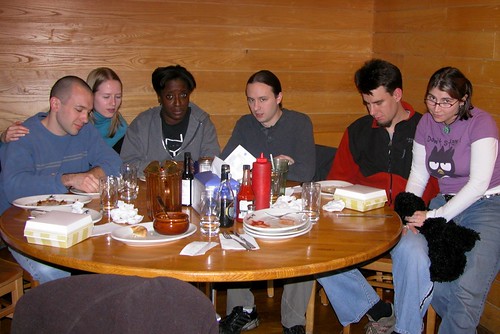
Here’s a case where it came in handy – the setting was a restaurant, with bad lighting and a big yellowish wood background.  The camera was held by a random waitress.  Once in a while you’ll get a server who’s studying photography in art school, but not always, so this tip is a great way to make sure you get a fun photo.  First, everyone is sad:

Saddest day of our lives at Tommy's

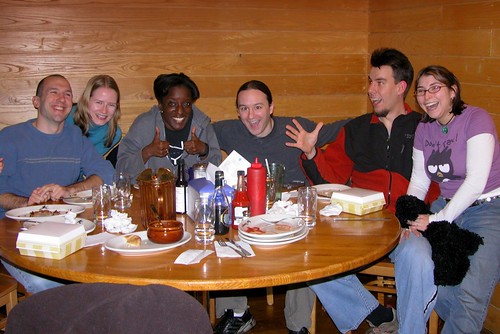
Then, they are insanely happy!  Doesn’t it look like we were having a good time?

Happiest day of our lives at Tommy's

Keep in mind that the sad photo doesn’t have to be convincing – note that two of the people here are having a hard time keeping a straight face.  We don’t want great acting, we want to shake everyone up a little.

DSCN2026

And it works!

DSCN2027

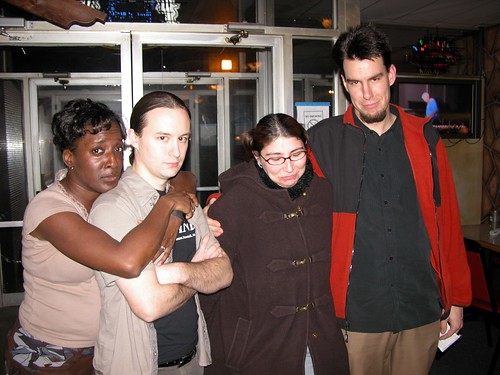
How do you take a good picture on a gray, rainy day?  Again, we use the procedure.  Saddest day of their lives :

DSCN1106

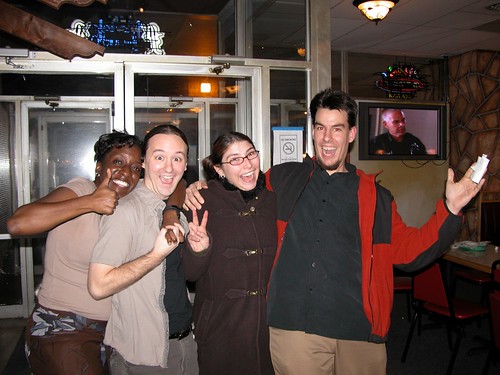
Happiest day of their lives!  Smiles despite the miserable weather.

DSCN1105

Go forth and use the technique.  I’ve created a Sad vs. Happy photo pool in Flickr.  Please share any shots you take to it.

Have you tried it and it worked?  Didn’t work?  Got a better idea?  Leave me a comment below.