Automated online backup with Mozy – the key word is automated

Mozy LogoMozy is a backup-service that will automatically back up your files on their server on a day-to-day basis when your computer is idle. I just signed up for it about a week ago.

This post is not really a product review. I haven’t used Mozy enough to fully recommend it yet and there are other similar services like Carbonite that I have no experience with. The important concept here is the automation, specifically the automation of tasks that I don’t really enjoy and normally take up big chunks of time.

Over the past year or so I have been trying to keep in mind the concept of opportunity cost–specifically, the cost of my time when I choose to spend it doing one thing and not another. So, in the past I would manually make backups every few months on DVDs. This takes time, requires me to remember all the drives and folders where I put things that are worth backing up, etc.

So now I think to myself, “what is the cost of using those hours to do backups instead of doing something else?” I could probably do some consulting work, and let’s say I would gain $50 an hour on average, taking into account time it takes to find people who need some work done, etc. Or I could work on refinishing my kitchen, work I don’t get paid for but that does prevent me from having to pay someone else. Or I could spend time with my wife, which I put a large value on.

So by installing Mozy, I have the piece of mind and mitigation of risk I had before (actually more, since these are finer-grained, off-site backups), and the $5.00 per month cost is more than made up by not wasting hundred of dollars in time over the course of the year.

Thanks to ITPro in the UK for reminding me the name of the service.

Picasa vs. iPhoto vs. Flickr vs. Panoramio

Ledges along Doan Brook in ClevelandEarlier I mentioned that I have some photos uploaded to Panoramio. I’ve also played with Flickr off and on, and have recently started uploading some photos there as well. To add to the confusion, I use Picasa to manage photos on my hard drive, and my wife uses iPhoto on her Mac. Picasa has a web albums feature, and I’m sure iPhoto has something similar with a .Mac account.

Why use four different services that overlap each other to such a degree? Picasa and iPhoto both do the important job of managing photos locally, Flickr seems to have the largest community and the most widgets written for it, and Panoramio integrates with Google Earth. Since I want to do all those things, I have to use them all.

There are ways to make them play nice together. You can use a Gmail account to email photos from Picasa to Flickr, and so far it seems to work fairly well. There are a few iPhoto plugins to upload to Flickr and you can use iPhoto to subscribe to Flickr photostreams. Google just bought Panoramio, so I’m sure there will be more integration there soon as well.

Even with all these options, there are some annoyances. Picasa’s keyword tagging is not very useful, it only allows one-word tags. I tried creating multi-word tags with dashes or by enclosing them in quotes, but Picasa ate the special characters. There’s also the complication of managing public photos vs private photos.

Still, it is amazing how well these different websites and programs work together, through the magic of RSS, web API, and plain old email.

If you’d like, you can see my Flickr photos here. You can also see my photos in Panoramio, or just look close enough in Google Earth, since a few of my photos now how up there.

Data Visualization with Maps

One of the best ways to show relationships in data is also one of the oldest: maps. There are lots of cool, fun visualizations out there like topic maps and tag clouds, but sometimes they emphasize form over function (and usability). Maps can be a great choice, even if your data is not directly geographical.

Here’s one example: a map of the United States showing where people use the terms “soda,” “pop,” or “coke.”

You might think this one was a pretty obvious choice, but you could definitely imagine someone using a pie chart to show the total percentages instead, throwing out a ton of information in the process.

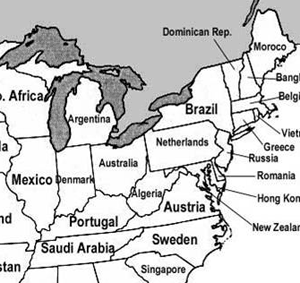
Here’s one that’s a little more clever: a map of the United States, which each state labeled by a country with the same GDP. from strange maps.

states-gdp.png

Now, you could argue with the precision of presentation since most people don’t know the exact GDP of Algeria off the top of their heads. But show them a table of figures and ten minutes later they still won’t know. This is a much more interesting and memorable presentation of the data.